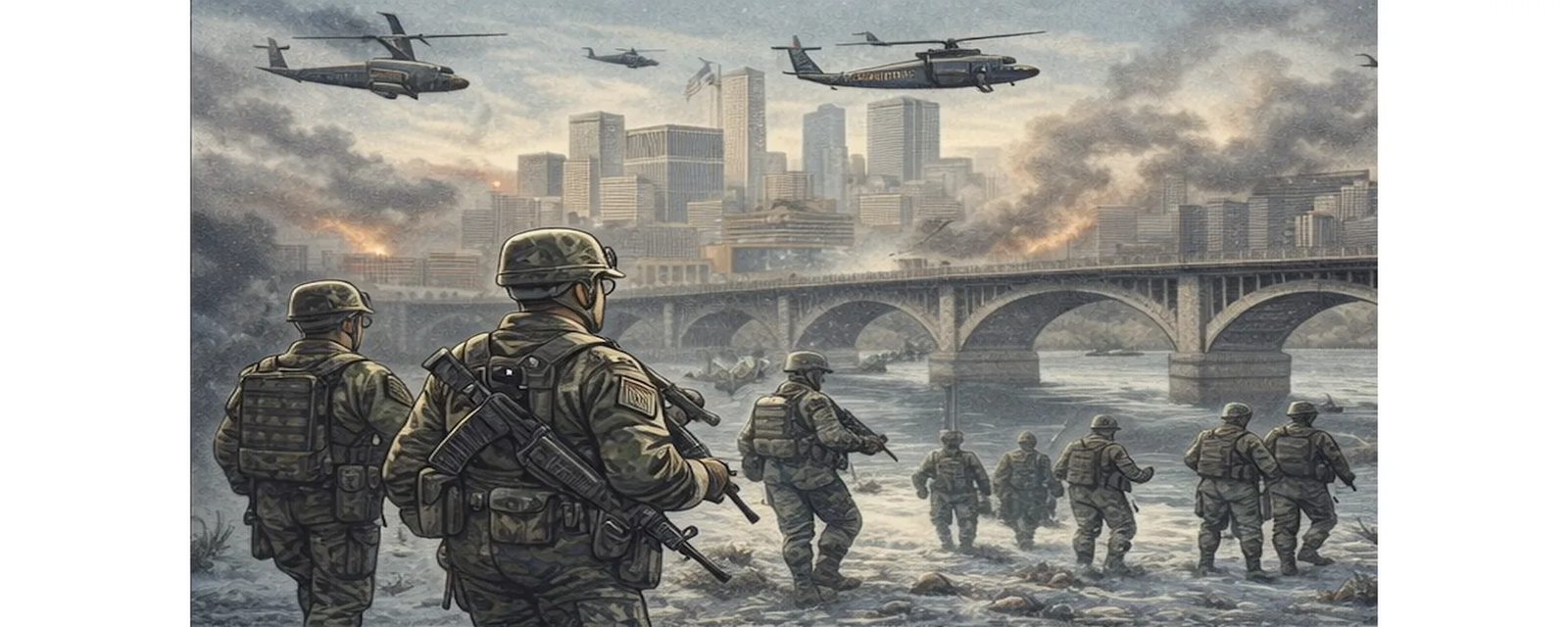
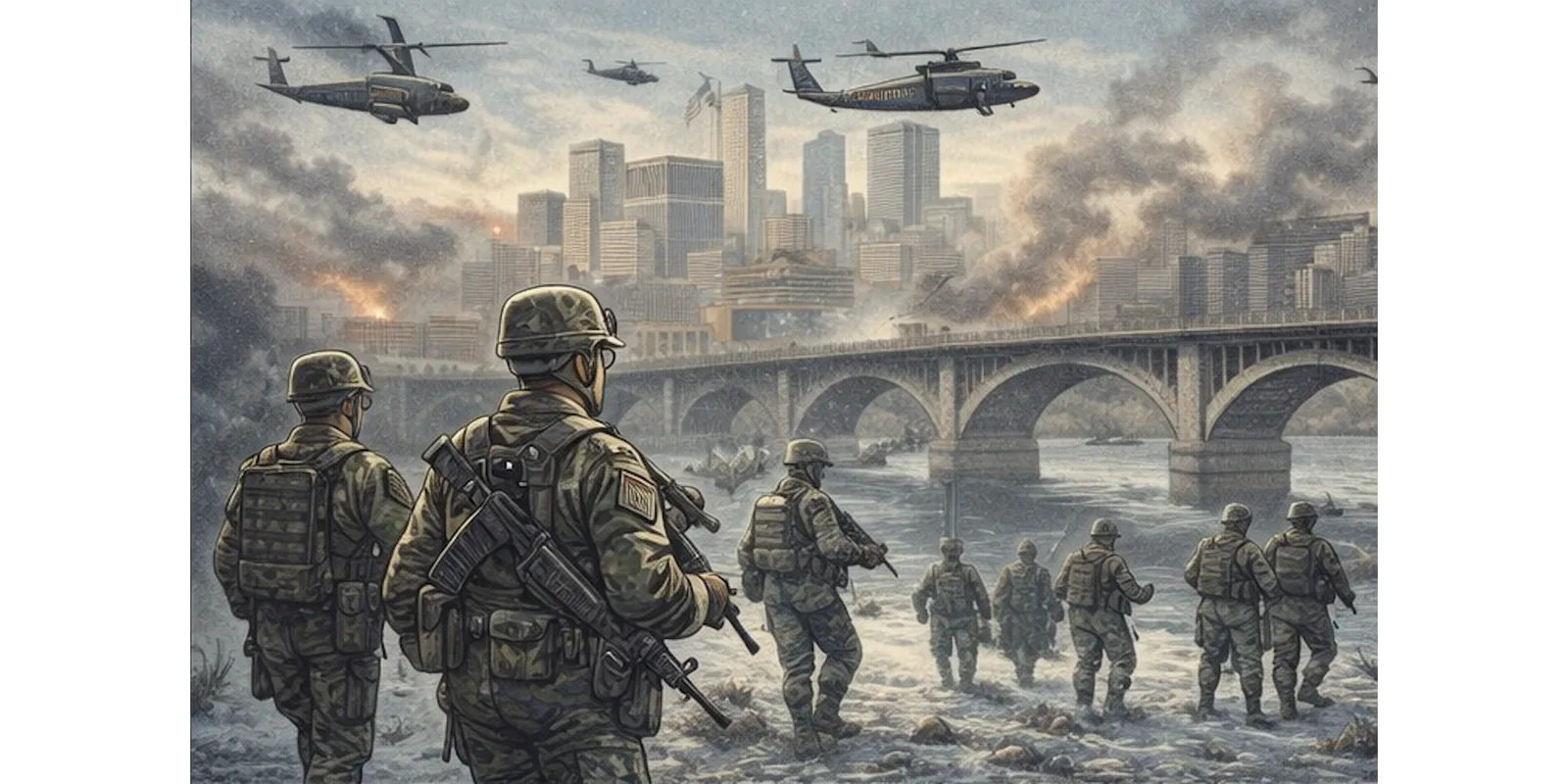
The police in this Minnesota city arrive already knowing what they are going to see. Not surprised, not outraged, yet, just tired in a particular way. Another body on the pavement, another masked man kneeling with no badge, no name, no number, no local accountability.
The city officers step out of their cars with that bitter taste already in their mouths because they have been here before and they know the script. They work for a city that still pretends society is a shared project, that if order is kept and people are protected, everyone can build a life.
They still believe - dimly, stubbornly - in pensions, in healthcare, in the idea that public service buys a kind of mutual security. They do not yet think about how thin that promise really is. The nausea they now feel at the scene is not moral outrage. Its what accompanies a kind of resignation.
The agent on the man’s back is Rex Ledger. High school only. Nights on the flat-top at a breakfast place off the interstate, eggs and grease and the smell that never leaves your hands.
Until he heard about ICE.
He took the job when the signing bonus hit fifty thousand.
Fifty thousand is a lot of money when you grew up watching your father waste away in public - missing teeth, wet pants, sleeping where the streetlights go dim.
Rex knows exactly what money buys.
It buys distance.
It buys a clean apartment. A car that starts reliably. A doctor with an office, not an RV. It buys a future where he does not die where he learned to stand. The man on the pavement says he is a citizen. Rex does not answer. He tightens the ties. That won’t happen to him. Not to him.
The city officers step closer. They ask for a warrant because that is still how legitimacy sounds to them. They ask for identification because force, to them, still needs a face.
Rex does not move. He hears the witnesses ringing around him, the breathing, the crying. He has learned not to look up.
Numbers matter. Throughput matters. The rest is noise.
Across town, in a room with sealed windows and sound-dampened corridors, Martin Vance watches the feed.
Mid-tier. GS pay, travel per diem - the sense of being almost there.
He knows the size of the machine now, the way money moves through it in quantities that no longer feel civic.
It reminds him of Iraq, of the day he watched a sergeant load a pallet1 of cash into a truck and drive away. He remembers thinking how easy it must be to be brazen when the sums are obscene.
He tells himself he is not brazen. He is careful. His mind turns, as it always does, to his mother. An accountant who did everything right.
She sold the grand piano first, then the furniture, then the car, then the house.
Chemo. Specialists. Travel. He remembers the ledger on the kitchen table, how the numbers in the columns narrowed until there was nothing left but choice.
He watched a television star - someone he grew up with - set up a GoFundMe to pay for cancer care and realized the lesson was public now. Justice? Legality? Those were words for people who could afford them.
He is at a hundred grand now, and with each arrest - no one says it aloud - there is a way the numbers climb. It will not happen to him. The solution is clear: process the injustice.
In a car with dark glass attorney general Helena Fairclough rehearses the words she’ll say.
She grew up on the redneck Riviera, learned the mottos early, learned how to smile while saying them.
She thinks of her grandfather as she always does at moments like this: first the photograph, black and white, aviators catching the light, linen shirt, teeth bright, jaw set.
Then the end. He died on a couch, yellowing, freezing, speaking nonsense. No insurance. “We’ll make do,” they said, because they were not doctors.
She remembers the smell. The way he sank into the cushions, the way dignity leaked out of him day by day.
She looks nothing like that memory now. Hair dyed blonde. Camera-ready. Strong. Hot. Decisive. Television likes her.
She knows what the fees will be.
Books. Panels. Consulting. She adds it up without meaning to.
Millions. Easily.
Lies? Of course they’re lies. But she has cast the die. There is no way she is going to put her girls through what she went through, and that takes money - real money, end-of-life money.
The name of her department makes her both laugh and retch.
Justice.
She grips the door handle as the car stops.
Worth it.
The indignity engineered into the system leaves no other rational choice.
Everyone in Minnesota already carried the image with them: the old man dragged into the snow in his underwear, hands cuffed, teeth chattering, shirtless under a child’s plaid blanket.
People had watched it in kitchens, on buses, at work. It had settled into the state like a bruise you keep pressing to see if it still hurts.
So, when it happened again, the crowd gathered fast, but not surprised.
Two ICE agents had a shirtless man pinned against a storefront just off Lake Street. He was shouting that he was a citizen. Someone in the crowd shouted it too. City cruisers arrived. Two officers stepped out - large, intimidating men. Careful. Already sickened by scenes like this.
One of the officers looked closely at the man’s face, now twisted in pain. He froze in his steps for half a second too long.
He did not know him by chance. He knew him because they had known each other forever. In a university-provided kindergarden 20 years ago their mothers had met and never separated, amazed that their two sons shared the same birthday. Those boys grew up together by default - same carpools, same scraped knees, same lunch tables - through middle school, until the one family returned to Guatemala where the father’s academic work was rewarded with a role in the state bank. A family of citizens. Strivers. Legal in the most American way possible.
He, the bigger of the two officers, asked for a warrant.
Rex Ledger did not answer. He heard the word citizen and felt the narrowing begin. Numbers. Throughput. Keep it moving.
The officer asked again.
Rex stepped forward and said the phrase that had been drilled into him as an ending.
“Federal supremacy.”
The taller cop did not raise his voice. He did not argue. He moved. His partner moved with him. There was no violence, only speed and mass and certainty. Hands went on wrists. Steel clicked. The crowd tightened, phones up, breath held.
Someone shouted, “Justice!” and the word spread - not as a chant, but as a fact being named.
The agents were walked - not dragged, walked - into squad cars. The crowd cheered. Then it went quiet, as if everyone realized at once what had just happened.
Rex thought fifty thousand had bought him distance once. He had not thought about what it would buy him back into.
Across town, Martin Vance watched the feed and felt the click he had been waiting for. This was not chaos. This was posture. This was interposition, clean and public.
He sent the message he had not sent before.
By midnight, the courtroom was full. Network cameras lined the walls. The judge leaned forward and began to speak the way judges used to speak to kings.
“Isn’t it true,” he said, “that a warrant is required to enter a home?”
“Isn’t it true that citizenship is not dissolved by assertion?”
The government lawyer began answers and lost them. Each question stacked another fact.
Unreasonable searches.
Seizure.
Due process.
Habeas.
The cadence was old. Deliberate. Familiar to anyone who had ever read why revolutions start.
Near dawn, the sound reached the room.
Helicopters.
Not one. Several.
The judge paused mid-sentence. His head turned slightly.
Martin felt the decision land before the alert vibrated on his phone there in his command center.
Rex felt it as the air changed in the holding room.
Helena Fairclough, inside the cavernous kitchen of her Kalorama home, read it on her screen and closed her eyes for a long time.
Washington had what it wanted.
Interposition.
Insurrection.
And this is where the mistake is usually made.
Insurrection did not mean tanks at the courthouse or soldiers replacing judges.
It meant something colder. Insurrection declared, it meant that federal action could now proceed without obstruction, because any obstruction - any pause, any question, any state resistance - was itself evidence of further insurrection.
Federal state control, backed by the Army.
It did not arrive as spectacle. It arrived as inevitability.
The pressure that had been provocation became flow.
Ther raids resumed, now shielded.
Then, in the absence of oversight, the rules began to blur.
Warrants became optional.
Detentions lengthened.
Courts delayed themselves into irrelevance.
The presence of the military did not govern; it guaranteed that no one else could.
Helena Fairclough signed statements that said nothing and authorized everything. She told herself what she had always told herself. She remembered the couch. The smell. Her grandfather yellowing, freezing, speaking nonsense while her family said, “We’ll make do,” because they were not doctors. She had promised herself her daughters would never learn that arithmetic. Speaking fees, books, panels, consulting - she had already priced it all in. Justice was for people who could afford to die slowly.
In “Free Minnesota,” as the president now derisively called it, Martin Vance coordinated under this new set of imperatives and did not raise his voice. Each new assault blurred into the last. And the bonuses stacked up.
He remembered Iraq again, the day he watched that sergeant. Before he drove away, the sergeant gave a nod toward the other truck loaded with a pallet of cash.
Right there.
Tens of millions. Maybe more? A dignified ending bought outright. No selling the house. No number narrowing to zero. No community clinic, her hand shaking, holding an absurd paper triangle cup.
He had been given the nod…but had done nothing.
He wouldn’t make the same mistake again.
To hell with constitutional rights.
Federal power now moved on the ground, backed by the Army, and nothing stood between him and a number where other people stopped mattering.
Rex went back to work.
He stopped hearing the shouting. He stopped seeing faces. He remembered his father dying in public, teeth gone, reeking, a body nobody bothered to shield. Fifty thousand had bought him escape. The next numbers would buy permanence. Whatever it took.
With that, the mechanics of an insurrectionary state simply kicked in.
Arrests without charge. Doors kicked in before dawn. People marched half-dressed into the snow. Detainees held standing until they urinated on themselves. Lawyers delayed until filings expired. Cameras blocked. Records sealed. Rights thinned into exceptions, then footnotes, then jokes.
Six states were placed under insurrection orders. Midterm elections were “suspended temporarily.” Control was declared necessary for stability. Forty-five House seats were filled by appointment.
Three Senate seats followed.
Seventy percent majorities in both houses.
The Supreme Court was quickly expanded to thirteen, and confirmations of the four new justices - each forty-year-old professors from “the right” law schools - followed.
The president died three months later.
The insurrection orders did not.
Martin Vance’s calculation that day was the coup de grâce, though few named it at the time. Getting enough money so that other people didn’t matter.
Enough so you could spend it out as you expired, and still die wearing your shirt.
By engineering a lien against every household - by making dignity at the end contingent on vast private wealth - mid-twentieth century America had forged the perfect instrument of corruption in a free society.
Leadership of a free people was no longer priceless.
Being lauded as a public figure meant nothing.
Being fêted as a public servant no longer had any value.
Because real freedom had a dollar figure.
And, at the scale of three hundred forty million souls, the state itself was the easiest way to secure your date with indignity.
The biggest payday.
The pallet.
Once the criminals realized this, and found a political valence - simple nativism - they needed accomplices.
The Helenas, Martins, and Rexes all lined up to exchange the millstone around their necks for the manacles around the necks of others.
In a free society.
With an unlimited line of minorities in America, there was a hundred years’ worth of targets against which the guns could be turned. Should these ever run out, ghosts alone would serve.
The founders believed that, by freeing men, there is a result: ambition unleashed. Your horizons? Limited only by your ambition.
Each participant, winners and losers alike, savoring their chances - it was obvious, loyalty to the system would become the highest nobility. Names on bridges. Peaceful quiet deaths at home.
Service to a system that raised up the dignity of all citizens.
Admiration that outlived money.
That was two hundred and fifty years ago.
Now the calculation was simpler. Clean sheets. Familiar food. A quiet room at the end - maybe even your own - eased painlessly off stage with dignity and repose. Surrounded by family and friends.
Given the actual cost of that, many decided now that no other citizen needed to matter.
So the clubs swung. The lies to camera came easily - spoken beneath a ten-gallon hat. “Jobs are up. Prices are down. Crime is low. Pay your taxes.”
Read Part 1 in the series - When Your State is Being Invaded by ICE and DHS
Read Part 2 in the series - On Interposition: The Minneapolis Call 911 Gamble
pallets of cash
Thanks for reading.
Entoraliten traces the old patterns of power, fear, corruption, and conscience into the crises of the present - helping readers see today's politics through the long memory of civilization.
For comments, corrections, tips, or collaboration: entoraliten@gmail.com